
Why south Dublin needs this route — and why the arguments against it don’t hold up
The Cabinteely Greenway has attracted its share of opposition. Some locals worry about traffic, others invoke decades of park tradition, and a few cite cycling statistics that sound alarming until you look at them closely. Let’s work through the actual evidence — because when you do, the case for this greenway becomes overwhelming.
“But Cycling Numbers Are Down!”
One of the most commonly cited objections to new cycle infrastructure is that fewer people are cycling anyway, so why bother? It’s true that overall cyclist counts in some locations have seen a modest dip — around 3% — but this figure obscures a far more important trend: commuter cycling journeys have increased by 50% in recent years.
That is not a coincidence. It is a direct consequence of where proper cycling infrastructure has been built. When people feel safe, they cycle. When they don’t, they don’t. The 3% figure isn’t an argument against the greenway — it’s an argument for it. It tells us that in areas without safe, dedicated infrastructure, cycling remains inaccessible to most people. The solution is more greenways, not fewer.
The Safety Data Is Clear
A Road Safety Authority (RSA) collision database review, covering a 12-year period from 2005 to 2016, examined collisions along the proposed Cabinteely Greenway route. The finding? Just one recorded incident along the route extent in over a decade — a minor collision in 2006 involving a motorcycle and a pedestrian. The route is predominantly off-road, which explains why the record is so clean.
Now compare that to the parallel N11 corridor. The same data review recorded six serious collisions and one fatal collision along that stretch. These are the roads that people currently have to use as an alternative. Every day that the greenway doesn’t exist, vulnerable road users — people walking, cycling, and wheeling — are pushed onto one of the most dangerous roads in the area.
The greenway doesn’t create risk. It removes it.
Brennanstown Road: The Traffic Argument Examined
Opponents of the scheme have pointed to traffic volumes on Brennanstown Road, citing figures of 6,000 to 7,000 vehicles per day as evidence that conditions are unsuitable for cycling infrastructure. Even setting aside whether that figure is accurate outside of race day traffic peaks, let’s take it at face value.
Ireland’s Cycle Design Manual provides clear guidance on exactly this question. It sets out, based on speed limits and peak hour traffic flows, what type of cycling provision is appropriate — and crucially, at what point segregated infrastructure is not just recommended but required. At traffic volumes anywhere near the figures being cited, on roads with speed limits typical of suburban and peri-urban environments, the Manual is unambiguous: segregated cycling infrastructure must be provided.
In other words, high traffic volumes on Brennanstown Road aren’t an argument against the greenway. Under national design guidance, they’re precisely the reason it’s needed.
“The Park Has Always Been No-Cycling Territory”
This claim is repeated with great confidence, but it doesn’t survive scrutiny. No public park in Ireland has maintained a strict no-cycling policy for 45 years. What has happened is that parks have lacked proper, safe, dedicated cycling infrastructure — which is an entirely different thing.
The absence of cycling infrastructure is not a policy triumph. It is a failure. It means that families with children, older adults on e-bikes, and anyone who isn’t a confident, experienced cyclist has been effectively excluded from using these spaces by bicycle. Building a greenway through or alongside the park doesn’t upend a proud tradition — it creates one, finally giving children and families the safe, well-designed space they need to cycle confidently.
What the Greenway Actually Offers
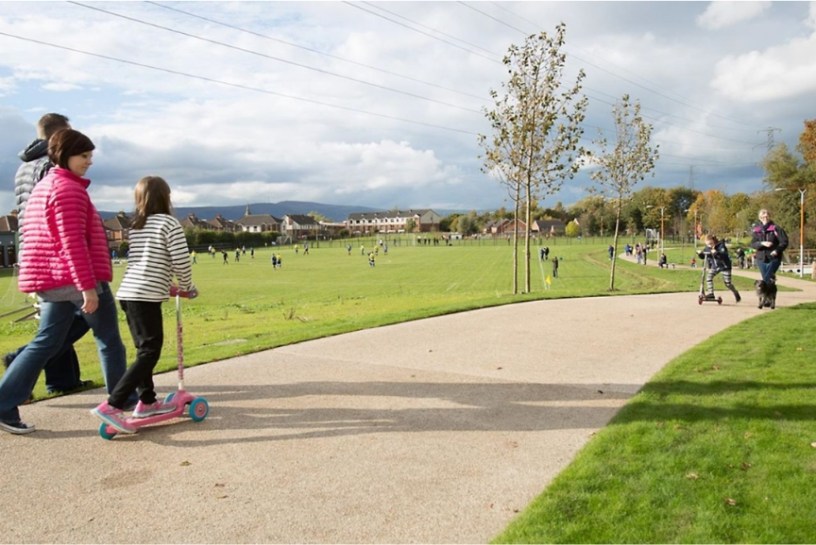
The Cabinteely Greenway would provide a dedicated, attractive, off-road route for walking, wheeling, and cycling in an area that currently forces anyone who wants to travel by bike into a choice between narrow residential streets or the heavily trafficked N11.
The evidence from elsewhere in Ireland and across Europe is consistent: when you build good infrastructure, people use it. Commuter cycling jumps. Families rediscover cycling as a mode of transport. Children gain independence. Roads get quieter. Communities become more connected.
South Dublin deserves this. The data supports it. National design guidance requires it.
It’s time to build it.
Your Voice Matters — Email Your Councillors Before Monday
The Cabinteely Greenway comes to a vote at Dún Laoghaire-Rathdown County Council this Monday, and your councillors need to hear from you before then. A short, polite email from a constituent carries real weight. Tell them why you support the greenway — whether it’s for your children’s safety, cleaner air, reducing car dependency, or simply because the evidence demands it. Ask them to vote yes.
Stillorgan LEA councillors:
- Cllr. Barry Saul (Fine Gael): bsaul@cllr.dlrcoco.ie
- Cllr Eoin O’Drisceoil eodriscoll@cllr.dlrcoco.ie (Fine Gael)
- Cllr. John Kennedy (Fine Gael): jkennedy@cllr.dlrcoco.ie
- Cllr. Eva Elizabeth Dowling (Green Party): edowling@cllr.dlrcoco.ie
- Cllr. John Hurley (Social Democrats): jhurley@cllr.dlrcoco.ie
- Cllr. Liam Dockery (Fianna Fáil): ldockery@cllr.dlrcoco.ie
Killiney-Shankill LEA councillors:
- Cllr. Jacqueline Burke (Fine Gael): jburke@cllr.dlrcoco.ie
- Cllr. Jim Gildea (Fine Gael): jgildea@cllr.dlrcoco.ie
- Cllr. Frank McNamara (Fine Gael): fmcnamara@cllr.dlrcoco.ie
- Cllr. Hugh Lewis (Independent): hlewis@cllr.dlrcoco.ie
- Cllr. Carrie Smyth (Labour): carriesmyth@cllr.dlrcoco.ie
- Cllr. Lauren Tuite (Green Party): ltuite@cllr.dlrcoco.ie
- Cllr. Dave O’Keeffe (People Before Profit): dokeeffe@cllr.dlrcoco.ie
You don’t need to write anything long or complicated. Just tell them who you are, where you live, and that you want them to vote yes for the Cabinteely Greenway on Monday. The deadline is days away — please take five minutes and send that email.
Sources: RSA Collision Database (2005–2016); Transport Infrastructure Ireland Cycle Design Manual; National cycling participation data. Councillor contact details sourced from dlrcoco.ie.
 Cabinteely Life